Alireza Mahyari
In the Tehran Camera collective, we have launched a series based on the vast archive of images left behind from the city of Tehran—from the late Qajar era to the present day. In this series, we carefully select
photographs and attempt to read them.
This reading can be described as a form of “photo archaeology”: an effort to uncover both the visible and hidden layers embedded in historical images of Tehran.
Each note accompanying an image may consist of two sections: “Delneveshteh” (Personal Reflection) and “Reading” (Urban Analysis). Not every photograph necessarily includes both sections; depending on the nature of the image, one or both approaches may be used.
The Delneveshteh section, as its name suggests, is rooted in lived experience in Tehran and often adopts an emotional, subjective, and introspective tone. The Reading section, however, seeks to analyze the selected image through the identification of buildings, architectural elements, and urban spaces.
Stay with us on this journey.
Image Description
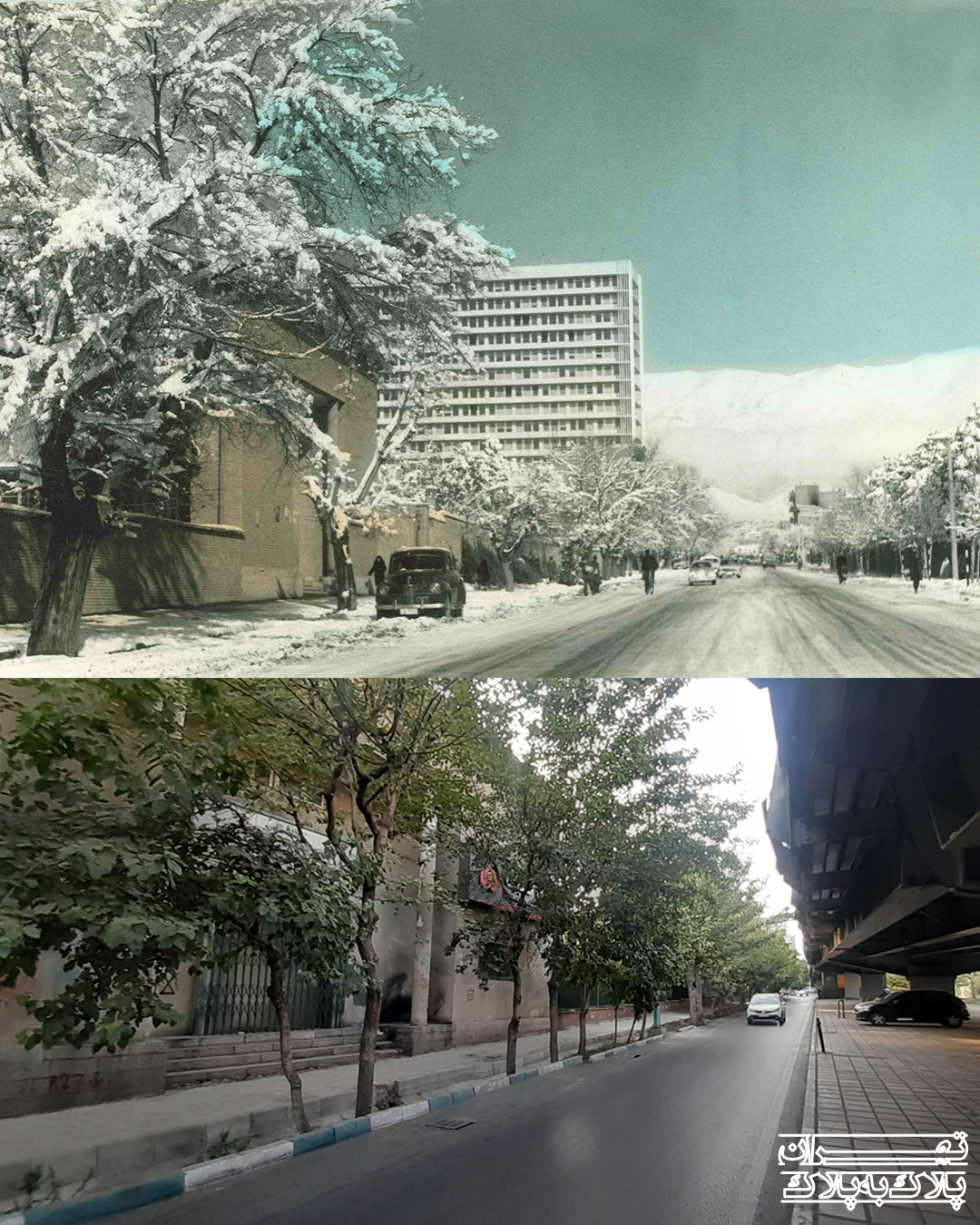
In the prepared image, the upper frame shows what is likely Hafez Street on a winter day in the 1960s (1340s SH).
The lower frame was captured in 1404 SH (2025), from almost the same angle, on a dust-filled summer day.
Delneveshteh | Personal Reflection
What does it mean to long for something—or to feel regret?
Regret can be defined as a deep sense of sorrow and remorse over something that has been lost and cannot be restored. This feeling may stem from past wrong decisions, missed opportunities, or failure to act at the right moment.
I believe this definition best captures the spirit of the photograph before us.
The image likely dates back to the 1960s and was probably taken during winter. The camera is positioned on Hafez Street, looking from south to north. The most striking element in the frame is the immense volume of snow—snow covering the northern mountains of Tehran, the streets, the trees, the cars, everything.
And here we arrive at the notion of regret.
It has probably been more than a decade since Tehran last experienced snowfall like this. We have not even seen half of such snow in recent years. Perhaps the last memories of it belong to our childhood.
But there is a second layer of regret: the morphological and visual transformation of Hafez Street itself. I do not expect this street to look exactly the same as it did sixty years ago. Change is inevitable. But everything has changed—often in the worst possible way.
Sometimes I ask myself:
What have we done to our city?
What have we done to our environment?
What will Tehran look like half a century from now?
Reading | Urban and Architectural Analysis
The historical photograph is framed on Hafez Street, looking from south to north. Beyond the presence of cars and pedestrians, two buildings with distinctly different architectural characters stand out in the image.
The building closer to the camera, located on the western side of Hafez Street, is the entrance to Manouchehri Elementary School—one of twelve modern schools built during the early Pahlavi period. This school was designed by architects Marcel D’Oeuvre and Aftandilian.
The taller building visible further down the street is the Oil Company Office Building, designed by Abdolaziz Farmanfarmaian.
Fortunately, both buildings are still standing today. However, evidence suggests that the school—now located within the campus of the former Polytechnic University (currently Amirkabir University of Technology)—is not in good condition. Unfortunately, public access and visitation are not possible.
The Oil Company building, on the other hand, still retains an active function and appears to be in relatively good condition. Nevertheless, this building too remains inaccessible to the general public.
💬 نظرات کاربران
📝 افزودن نظر جدید